Written by MELISSA DICKSON JACKSON | Photographed by CLAY NEELY
Local painter Ron Mancil was in his early 20s in 1980 when his mother, Marie, died at the age of 58. Born in Brandenburg, Germany, Marie Heyl grew up in what would become East Berlin, where she learned to draw and paint. She’d told her son about an idyllic youth in the years before the Second World War, and then about the frantic, heartbreaking escape negotiated by her father as the war neared its conclusion when Russian soldiers advanced on Berlin.
Escaping west by train, Marie spent the remainder of her youth in the household of a paternal aunt in Frankfurt. Her father stayed behind and found himself a citizen of a new country, the German Democratic Republic, cut off from the daughter he’d sent west and the life she was building, one that would eventually take her to America.
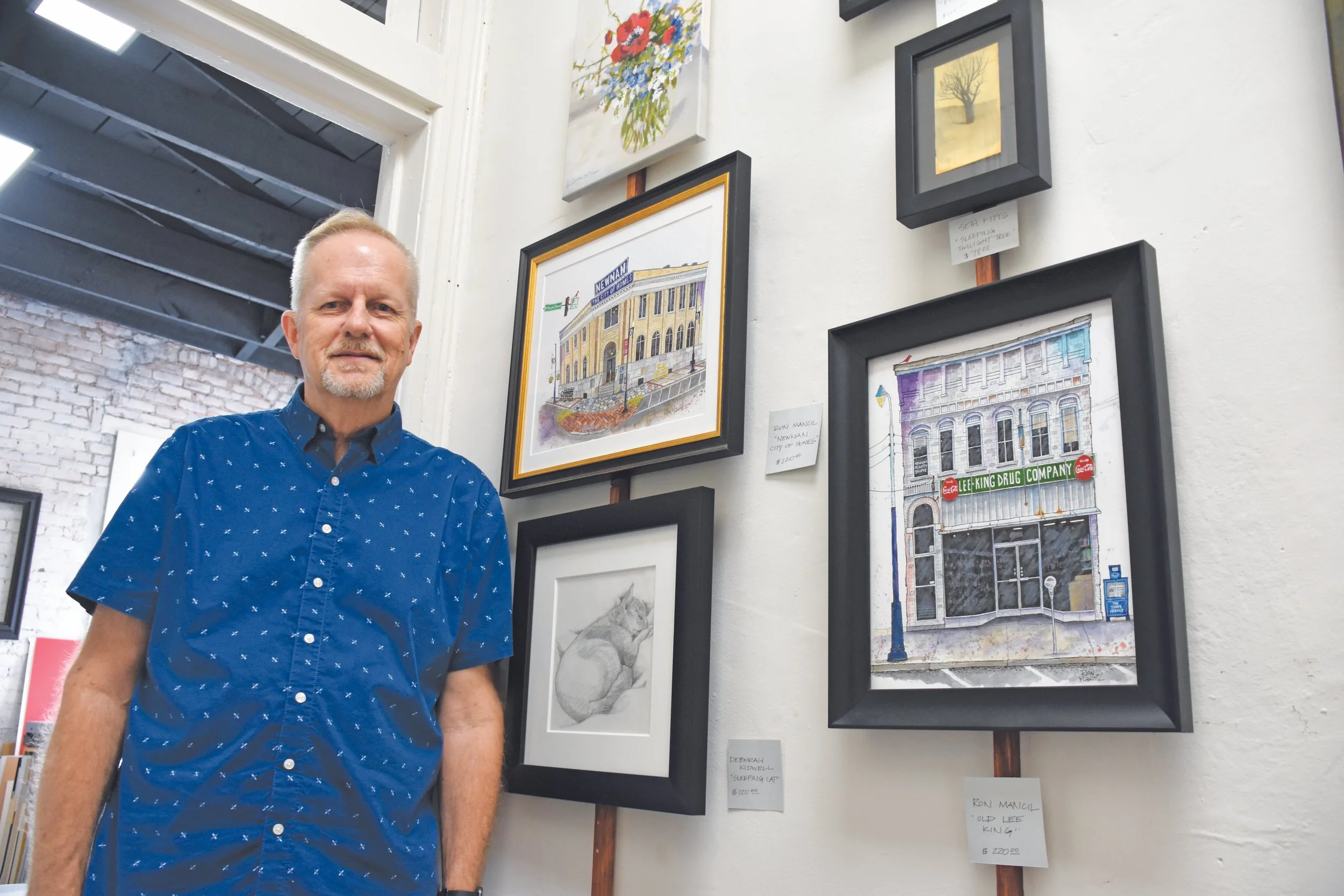
Artist Ron Mancil
“I don’t think they ever saw each other again,” says Mancil.
In Frankfurt, Marie met an American serviceman, Marvin Mashburn Mancil, a handsome, bespectacled Southern boy with deep Alabama roots. It was 5,000 miles away in Andalusia, Ala., that Marie and Marvin raised a family – and there that their son Ron learned to draw and to paint like his mother had as a girl.
“Growing up, my sister and I never really knew she was an artist,” Ron recalls.
“I guess she just didn’t want to fool with it while she was raising us,” he says. “When I went off to college at Troy, she broke out the paints and started painting, and I was amazed at the work she did. I graduated, moved back home, went to work – and she was still painting.”
A Mother’s Artistic Inspiration
Recently married and leaning into his career as an industrial engineer in the textile industry, Ron didn’t have much time for the art of his youth after his mother died. He was too busy building his own life and spent his free time kayaking, golfing, and fishing.
But something about the piece his mother left half-finished on her easel in 1980 drew him back to the paintbrush.
“She was right in the middle of one of her paintings,” he says. “It sat on the easel for months. My dad didn’t move it. I wasn’t living in the house, but he still had it there. So I went over one day and sat down at the easel.”
It was at that moment, Ron confesses, that something undeniable clicked.
“I finished the painting the best I could, signed her name the way she signed it, and put my name underneath it,” he says.
“My gosh," he said to himself that day. “You should do this.”
He sat before his mother’s easel scanning the scene they had created together: a boat and cabin in the woods produced in a mix of their two styles. Since that moment, wherever he worked, in whatever city, with whatever job description, he was also a practicing painter.
Finding His Own Way
While working with his mother’s oil paints, Ron learned that the drying time was too long and awkward for him. As a result, his medium most of his life was faster-drying, more accommodating acrylic. His style was rural naturalism with an eye toward an engineer’s accurate depiction, but as the artist often declares, never with a ruler.
As a life-long history buff, Ron was always drawn to quirky architecture with the character only age can deliver. That eye for character started early: as his high school’s newspaper cartoonist, Ron once sketched a caricature of a history teacher, Bill Kennedy, mid-lecture, foot propped on his desk, tie askew. Kennedy confiscated the drawing on the spot; Ron was sure he was in for it. Years later, at graduation, he spotted it still pinned to Kennedy’s bulletin board.
These days, that same instinct for historic character shows up not in faces but in façades: old buildings, barns and bridges rendered with the same fondness and a touch of whimsy. As an Alabama resident, he painted the landmarks of Andalusia, including its historic 1910 Prestwood Bridge from a photo he took shortly before it collapsed during a 1985 attempted relocation.
Ron waited years before finally listening to his wife’s urging to document the historic relic: “Nobody’s ever going to be interested in that,”
Ron told his wife. “That’s just not something I want to do.”
Old Buildings Become New Art
About 15 years ago, he finally painted it, and it’s been perhaps the single most popular of all his works, Ron admits, noting that prints of the Prestwood Bridge outsell nearly everything else he does.
“That original, I will never sell,” he says. “That bridge was the subject of a lot of ghost stories back in Andalusia. It was a rickety bridge, a hundred feet above the [Conecuh] River, and boys used to take their girlfriends out there to scare them, ’cause it was so rickety you could see the river through the slats.”
The 11x14 acrylic on canvas of Andalusia’s infamous haunted bridge still hangs on his studio wall.
For nearly a decade, Ron has called Newnan home since moving here with wife Ann who wanted to be closer to family and grandchildren. Their daughter and one son had both settled in the Newnan area, so the couple relocated. Another son, an Episcopal priest, still lives in Andalusia.
The buildings Ron documents now are the historic favorites of Coweta County: places like the courthouse, the old Lee-King Drug Company on Newnan's Square, Newnan High School and the Carnegie Library. On his website, he describes himself as an “urban sketcher and watercolor artist,” a nod to the loose, immediate quality of his ink-and-watercolor work, even when the buildings themselves sit in small towns rather than cities.
The artist also does commissions of homes and buildings.
“The money keeps me going, it helps buy my supplies, and that part's nice,” he says. “I love to see the expression on people’s faces when they see it. I think one of the main things that makes good art is when people can connect with it. You make a connection with them, and that's what excites me.”
Making the Art His
Over the decades of exploring his identity and affinities as a painter, Ron has discovered he loves fast-drying ink and watercolor. It was a medium he resisted for years. A friend in Birmingham, the watercolorist Warren Mullins, had long urged him to try it, certain he would take to it. Ron refrained, insisting acrylic was his medium.
When Ron finally gave ink and watercolor a try, he learned Mullins had been right all along. It satisfies Ron’s intense daily focus on one painting at a time in his “man cave, bonus room, above the garage.” This ink and watercolor work is what he’s best known for locally.
The artist starts early each day, sometimes before daybreak, working through his list of commissions and personal selections while listening to smooth jazz and shutting out the rest of the world. He works on his art until around noon, and then he moves on to the other necessities of life: “piddling in the yard,” home repair and, until recently, a part-time job as a merchandiser at Lowe’s.
In July, he turned his attention to painting as his primary occupation, and Newnan will certainly be richer for it.
Looking back, Ron doesn’t regret the years he spent away from the easel, the decades chasing a vanishing textile industry across three states while golf, kayaking, fishing and painting waited their turn.
“I don’t have any regrets at all,” he says.
Asked what he’d tell his younger self, though, he doesn't hesitate: “Paint more.”
It’s the same advice he says he’d give his future self.
Now, with Lowe’s behind him and a waiting list of commissions ahead, he finally has the chance.
You’ll find Ron Mancil and his art at Newnan’s Market Day on the first Saturday of each month from March through December. View his work also at Fine Lines Art and Framing inside David Boyd Jr. Gallery at 14 East Washington Street in Newnan. NCM
